


Everyone goes to Paju. Almost nobody goes to Yanggu. It is the same border — 150 km further east, where the line runs through mountains instead of farmland, and where you need paperwork that no coach from Seoul will do for you.
It is about 2 hours from Seoul by road (141 km). Here is what is actually there, and what it takes to get in.
First: you have to sign in
The things most people come for — the Eulji Observatory and the Fourth Tunnel — sit inside the Civilian Control Line. You cannot simply drive up.
Access is handled at the Yanggu Unification Hall, where you complete an entry application before going in. A few things to know:
- Entry runs in four sessions a day, each capped at about 160 people or 20 vehicles. Weekends and peak season fill early.
- The Unification Hall runs roughly 09:00–16:00 and is closed on Mondays, on 1 January, and on the mornings of Seollal and Chuseok.
- You can book ahead through the security-tourism reservation system, or apply on the spot — on a busy day, on the spot is a gamble.
- Inside the line, wandering off on your own is not allowed. Walking routes are done with an accredited guide.
Bring your passport. This is a border county and ID is the whole basis of the system.
Eulji Observatory — and the season nobody mentions
From the observatory you look straight into North Korea across the mountains. It is a very different view from Dora in Paju: no apartment blocks, no propaganda village, just ridgelines going on and on.
It opens from early March to the end of November and does not run in winter. If you are planning a January trip to Korea and this is why you were coming to Yanggu, change the plan or change the month. We would rather tell you now.
The Fourth Tunnel — check before you count on it
Found on 3 March 1990, the Fourth Infiltration Tunnel is the one you do not walk through: visitors ride a small electric train into the rock.
Its operating status has been listed as temporarily suspended. We do not know as we write this whether it has resumed, and neither does any page that tells you confidently that it is open. It is worth a phone call to the Unification Hall on the day you plan to go.
The Punchbowl
Thirty minutes and 28 km from the town centre is the Haean Basin, which American officers in the war looked down into and named the Punchbowl, because that is exactly what it looks like: a round bowl of farmland ringed by ridges.
The ridges around it have names that still mean something here — this was some of the hardest fighting of the war. Today it is cabbage fields and silence, which is its own kind of strange.
Dootayeon
A valley closed to civilians for fifty years, which is why the water is still clear enough to see the bottom and the only sound is the stream. You go in with an accredited guide or you do not go in.
The centre of the Korean Peninsula
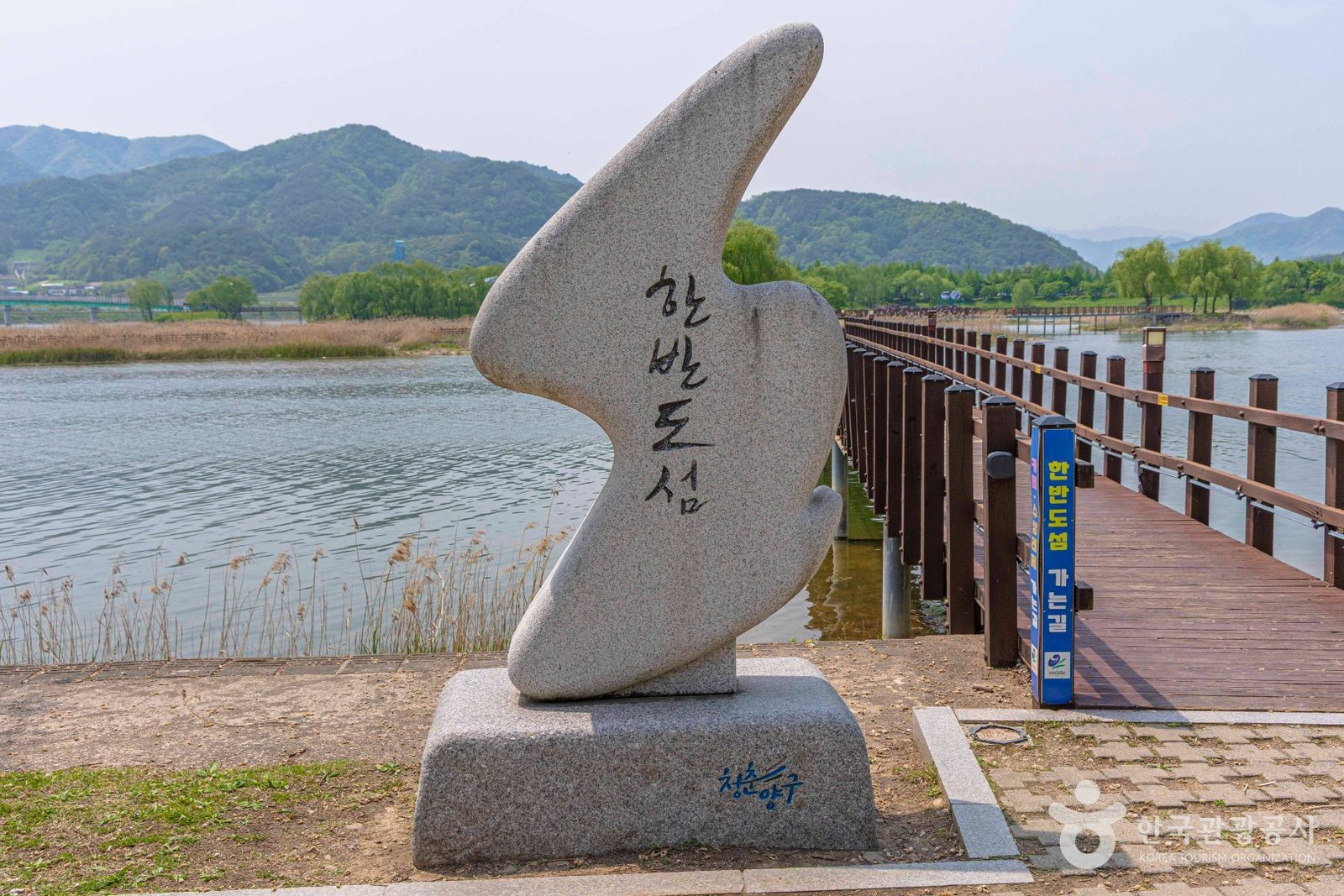
Two minutes from the town centre, a monument marks the geographic centre of the Korean Peninsula — measured for the whole peninsula, north and south together. You walk the last 800 m uphill to reach it.
It is a modest thing to look at. What it means takes a moment longer: you are standing in the middle of a country that is cut in half about 20 km north of where your feet are.
Park Soo-keun — the reason to stay the afternoon
Yanggu is the birthplace of Park Soo-keun, one of the painters Koreans love most: grey, granular, almost textureless pictures of ordinary women doing ordinary work in a poor country.
The county museum stands on the site of his birthplace and has grown into five buildings — the memorial hall, a contemporary gallery, the Park Soo-keun Pavilion, an archive and a children’s museum. It is outside the Civilian Control Line, so no paperwork, and it is the thing our travellers most often say they did not expect.
White porcelain, and lunch
Yanggu sat on good white clay, and its porcelain was fine enough to be sent to the royal household as tax. There is a museum for it.
Eat the siraegi — dried radish greens, a famine food that Yanggu turned into something people now drive here for. Add gomchwi with pork belly and a table of mountain greens, and you have the local meal.
When to go
Late spring to November. The observatory is shut in winter, the mountain walking is the point, and the autumn colour up here arrives earlier and harder than in Seoul.
Pack warmer than you think. Yanggu is inland and high, and it is reliably colder than Seoul on the same day.
Can you do it yourself?
Honestly: partly. The museum, the porcelain, the centre monument and lunch are all open to anyone who drives up.
The border itself is harder. The application is in Korean, the sessions cap out, the observatory closes for the season, the tunnel’s status moves, and the walking routes need an accredited guide. That is a lot of moving parts for one day of a two-week holiday.
We have been bringing people here for years and we still telephone ahead every time.
We filmed one of these trips
Delicious Yanggu DMZ trip with K-granny — eight minutes on our YouTube channel.
More on Yanggu from our own trips: what it was like · the schedule we ran
Our Yanggu trips
Private, your group only. We handle the entry applications and we call ahead about the tunnel.
Yanggu, the eastern DMZ, 3 days 2 nights — from $1,194 per person
Gangwon-do: temple stay, cooking and the DMZ, 5 days 4 nights — from $2,100 per person
Tell us your dates and we will come back with a plan and a price.
Photograph: ©Korea Tourism Organization — Hwang Sunghoon. Used under the Korea Open Government License (KOGL) Type 1.
1 Comment